|
|

Templar Quest in the Languedoc, France
Knights Templar, Cathars & Troubadours, Rennes-le-Château
The Primitive Rule of the Templars
Translated by Mrs. Judith M. Upton-Ward
(Reprinted by kind permission of the author)
In January 1128, a Church council met in Troyes in Champagne. Saint Bernard, produced a primitive rule the Order. This primitive rule, known as “Latin Rule” was later translated, adapted, reformed and supplemented. The Rule is divided in several parts :
- The primitive Rule (articles 1 to 76)
- Hierarchical statutes (articles 77 to 197)
- The election of the Master of the Order (articles 198 to 223)
- The Penalties (articles 224 to 278)
- Conventual life of the brothers (articles 279 to 385)
- The Chapters (articles 386 à 415)
- The Penitences (articles 416 to 542)
- Detals of Penitences (articles 543 to 656)
- Reception in the Order (articles 657 to 686)
This translation of the original, or primitive, Rule of the Templars is based on the 1886 edition of Henri de Curzon, La Régle du Temple as a Military Manual, or How to Deliver a Cavalry Charge. It represents the Rule given to the fledgling Knights of the Temple by the Council of Troyes, 1129, although "it must not be forgotten that the Order had been in existence for several years and had built up its own traditions and customs before Hugues de Payens' appearance at the Council of Troyes. To a considerable extent, then, the Primitive Rule is based upon existing practices." (Upton-Ward, p. 11)
This translation is excerpted from Judith Upton-Ward's The Rule of the Templars, Woodbridge: The Boydell Press, 1992, and is reprinted here with permission.
The Primitive Rule
Here begins the prologue to the Rule of Temple
1. We speak firstly to all those who secretly despise their own will and desire with a pure heart to serve the sovereign king as a knight and with studious care desire to wear, and wear permanently, the very noble armour of obedience. And therefore we admonish you, you who until now have led the lives of secular knights, in which Jesus Christ was not the cause, but which you embraced for human favour only, to follow those whom God has chosen from the mass of perdition and whom he has ordered through his gracious mercy to defend the Holy Church, and that you hasten to join them forever.
2. Above all things, whosoever would be a knight of Christ, choosing such holy orders, you in your profession of faith must unite pure diligence and firm perseverence, which is so worthy and so holy, and is known to be so noble, that if it is preserved untainted forever, you will deserve to keep company with the martyrs who gave their souls for Jesus Christ. In this religious order has flourished and is revitalised the order of knighthood. This knighthood despised the love of justice that constitutes its duties and did not do what it should, that is defend the poor, widows, orphans and churches, but strove to plunder, despoil and kill. God works well with us and our saviour Jesus Christ; He has sent his friends from the Holy City of Jerusalem to the marches of France and Burgundy, who for our salvation and the spread of the true faith do not cease to offer their souls to God, a welcome sacrifice.
3. Then we, in all joy and all brotherhood, at the request of Master Hugues de Payens, by whom the aforementioned knighthood was founded by the grace of the Holy Spirit, assembled at Troyes from divers provinces beyond the mountains on the feast of my lord St Hilary, in the year of the incarnation of Jesus Christ 1128, in the ninth year after the founding of the aforesaid knighthood. And the conduct and beginnings of the Order of Knighthood we heard in common chapter from the lips of the aforementioned Master, Brother Hugues de Payens; and according to the limitations of our understanding what seemed to us good and beneficial we praised, and what seemed wrong we eschewed.
4. And all that took place at that council cannot be told nor recounted; and so that it should not be taken lightly by us, but considered in wise prudence, we left it to the discretion of both our honourable father lord Honorius and of the noble patriarch of Jerusalem, Stephen, who knew the affairs of the East and of the Poor Knights of Christ, by the advice of the common council we praised it unanimously. Although a great number of religious fathers who assembled at that council praised the authority of our words, nevertheless we should not pass over in silence the true sentences and judgements which they pronounced.
5. Therefore I, Jean Michel, to whom was entrusted and confided that divine office, by the grace of God served as the humble scribe of the present document by order of the council and of the venerable father Bernard, abbot of Clairvaux.
The Names of the Fathers who Attended the Council
6. First was Matthew, bishop of Albano, by the grace of God legate of the Holy Church of Rome; R[enaud], archbishop of Reims; H(enri), archbishop of Sens; and then their suffragans: G(ocelin], bishop of Soissons; the bishop of Paris; the bishop of Troyes; the bishop of Orlèans; the bishop of Auxerre; the bishop of Meaux; the bishop of Chalons; the bishop of Laon; the bishop of Beauvais; the abbot of Vèzelay, who was later made archbishop of Lyon and legate of the Church of Rome; the abbot of Cîteaux; the abbot of Pontigny; the abbot of Trois-Fontaines; the abbot of St Denis de Reims; the abbot of St Etienne de Dijon; the abbot of Molesmes; the above-named B[ernard], abbot of Clairvaux: whose words the aforementioned praised liberally. Also present were master Aubri de Reims; master Fulcher and several others whom it would be tedious to record. And of the others who have not been listed it seems profitable to furnish guarantees in this matter, that they are lovers of truth: they are count Theobald; the count of Nevers; Andrè de Baudemant. These were at the council and acted in such a manner that by perfect, studious care they sought out that which was fine and disapproved that which did not seem right.
7. And also present was Brother Hugues de Payens, Master of the Knighthood, with some of his brothers whom he had brought with him. They were Brother Roland, Brother Godefroy, and Brother Geoffroi Bisot, Brother Payen de Montdidier, Brother Archambaut de Saint Amand. The same Master Hugues with his followers related to the above-named fathers the customs and observances of their humble beginnings and of the one who said: Ego principium qui et loquor vobis, that is to say: 'I who speak to you am the beginning,' according to one's memory.
8. It pleased the common council that the deliberations which were made there and the consideration of the Holy Scriptures which were diligently examined with the wisdom of my lord H[onorius], pope of the Holy Church of Rome, and of the patriarch of Jerusalem and with the assent of the chapter, together with the agreement of the Poor Knights of Christ of the Temple which is in Jerusalem, should be put in writing and not forgotten, steadfastly kept so that by an upright life one may come to his creator; the compassion of which Lord [is sweeter] than honey when compared with God; whose mercy resembles oine, and permits us to come to Him whom they desire to serve. Per infinita seculorum secula. Amen.
Here Begins the Rule of the Poor Knighthood of the Temple
9. You who renounce your own wills, and you others serving the sovereign king with horses and arms, for the salvation of your souls, for a fixed term, strive everywhere with pure desire to hear matins and the entire service according to canonical law and the customs of the regular masters of the Holy City of Jerusalem. 0 you venerable brothers, similarly God is with you, if you promise to despise the deceitful world in perpetual love of God, and scorn the temptations of your body: sustained by the food of God and watered and instructed in the commandments of Our Lord, at the end of the divine office, none should fear to go into battle if he henceforth wears the tonsure.
10. But if any brother is sent through the work of the house and of Christianity in the East – something we believe will happen often – and cannot hear the divine office, he should say instead of matins thirteen paternosters; seven for each hour and nine for vespers. And together we all order him to do so. But those who are sent for such a reason and cannot come at the hours set to hear the divine office, if possible the set hours should not be omitted, in order to render to God his due.
The Manner in which Brothers should be Received
11. If any secular knight, or any other man, wishes to leave the mass of perdition and abandon that secular life and choose your communal life, do not consent to receive him immediately, for thus said my lord St Paul: Probate spiritus si ex Deo sunt. That is to say: 'Test the soul to see if it comes from God.' Rather, if the company of the brothers is to be granted to him, let the Rule be read to him, and if he wishes to studiously obey the commandments of the Rule, and if it pleases the Master and the brothers to receive him, let him reveal his wish and desire before all the brothers assembled in chapter and let him make his request with a pure heart.
On Excommunicated Knights
12. Where you know excommunicated knights to be gathered, there we command you to go; and if anyone there wishes to join the order of knighthood from regions overseas, you should not consider worldly gain so much as the eternal salvation of his soul. We order him to be received on condition that he come before the bishop of that province and make his intention known to him. And when the bishop has heard and absolved him, he should send him to the Master and brothers of the Temple, and if his life is honest and worthy of their company, if he seems good to the Master and brothers, let him be mercifully received; and if he should die in the meanwhile, through the anguish and torment he has suffered, let him be given all the benefits of the brotherhood due to one of the Poor Knights of the Temple.
13. Under no other circumstances should the brothers of the Temple share the company of an obviously excommunicated man, nor take his own things; and this we prohibit strongly because it would be a fearful thing if they were excommunicated like him. But if he is only forbidden to hear the divine office, it is certainly possible to keep company with him and take his property for charity with the permission of their commander.
On Not Receiving Children
14. Although the rule of the holy fathers allows the receiving of children into a religious life, we do not advise you to do this. For he who wishes to give his child eternally to the order of knighthood should bring him up until such time as he is able to bear arms with vigour, and rid the land of the enemies of Jesus Christ. Then let the mother and father lead him to the house and make his request known to the brothers; and it is much better if he does not take the vow when he is a child, but when he is older, and it is better if he does not regret it than if he regrets it. And henceforth let him be put to the test according to the wisdom of the Master and brothers and according to the honesty of the life of the one who asks to be admitted to the brotherhood.
On Brothers who Stand Too Long in Chapel
15. It has been made known to us and we heard it from true witnesses that immoderately and without restraint you hear the divine service whilst standing. We do not ordain that you behave in this manner, on the contrary we disapprove of it. But we command that the strong as well as the weak, to avoid a fuss, should sing the psalm which is called Venite, with the invitatory and the hymn sitting down, and say their prayers in silence, softly and not loudly, so that the proclaimer does not disturb the prayers of the other brothers.
16. But at the end of the psalms, when the Gloria patri is sung, through reverence for the Holy Trinity, you will rise and bow towards the altar, while the weak and ill will incline their heads. So we command; and when the explanation of the Gospels is read, and the Te deum laudamus is sung, and while all the lauds are sung, and the matins are finished, you will be on your feet. In such a manner we command you likewise to be on your feet at matins and at all the hours of Our Lady.
On the Brothers' Dress
17. We command that all the brothers' habits should always be of one colour, that is white or black or brown. And we grant to all knight brothers in winter and in summer if possible, white cloaks; and no-one who does not belong to the aforementioned Knights of Christ is allowed to have a white cloak, so that those who have abandoned the life of darkness will recognise each other as being reconciled to their creator by the sign of the white habits: which signifies purity and complete chastity. Chastity is certitude of heart and healthiness of body. For if any brother does not take the vow of chastity he cannot come to eternal rest nor see God, by the promise of the apostle who said: Pacem sectamini cum omnibus et castimoniam sine qua nemo Deum videbit. That is to say: 'Strive to bring peace to all, keep chaste, without which no-one can see God.'
18. But these robes should be without any finery and without any show of pride. And so we ordain that no brother will have a piece of fur on his clothes, nor anything else which belongs to the usages of the body, not even a blanket unless it is of lamb's wool or sheep's wool. We command all to have the same, so that each can dress and undress, and put on and take off his boots easily. And the Draper or the one who is in his place should studiously reflect and take care to have the reward of God in all the above-mentioned things, so that the eyes of the envious and evil-tongued cannot observe that the robes are too long or too short; but he should distribute them so that they fit those who must wear them, according to the size of each one.
19. And if any brother out of a feeling of pride or arrogance wishes to have as his due a better and finer habit, let him be given the worst. And those who receive new robes must immediately return the old ones, to be given to the squires and sergeants and often to the poor, according to what seems good to the one who holds that office.
On Shirts
20. Among the other things, we mercifully rule that, because of the great intensity of the heat which exists in the East, from Easter to All Saints, through compassion and in no way as a right, a linen shirt shalt be given to any brother who wishes to wear it.
On Bed Linen
21. We command by common consent that each man shall have clothes and bed linen according to the discretion of the Master. It is our intention that apart from a mattress, one bolster and one blanket should be sufficient for each; and he who lacks one of these may have a rug, and he may use a linen blanket at all times, that is to say with a soft pile. And they will at all times sleep dressed in shirt and breeches and shoes and belts, and where they sleep shall be lit until morning. And the Draper should ensure that the brothers are so well tonsured that they may be examined from the front and from behind; and we command you to firmly adhere to this same conduct with respect to beards and moustaches, so that no excess may be noted on their bodies.
On Pointed Shoes' and Shoe-Laces
22. We prohibit pointed shoes and shoe-laces and forbid any brother to wear them; nor do we permit them to those who serve the house for a fixed term; rather we forbid them to have shoes with points or laces under any circumstances. For it is manifest and well known that these abominable things belong to pagans. Nor should they wear their hair or their habits too long. For those who serve the sovereign creator must of necessity be born within and without through the promise of God himself who said: Estote mundi quia ego mundus sum. That is to say: 'Be born as I am born.'
How They Should Eat
23. In the palace, or what should rather be called the refectory, they should eat together. But if you are in need of anything because you are not accustomed to the signs used by other men of religion, quietly and privately you should ask for what you need at table, with all humility and submission. For the apostle said: Manduca panem tuum cum silentio. That is to say: 'Eat your bread in silence.' And the psalmist: Posui ori meo custodiam. That is to say: 'I held my tongue.' That is, 'I thought my tongue would fail me.' That is, 'I held my tongue so that I should speak no ill.'
On the Reading of the Lesson
24. Always, at the convent's dinner and supper, let the Holy Scripture be read, if possible. If we love God and all His holy words and His holy commandments, we should desire to listen attentively; the reader of the lesson will tell you to keep silent before he begins to read.
On Bowls and Drinking Vessels
25. Because of the shortage of bowls, the brothers will eat in pairs, so that one may study the other more closely, and so that neither austerity nor secret abstinence is introduced into the communal meal. And it seems just to us that each brother should have the same ration of wine in his cup.
On the Eating of Meat
26. It should be sufficient for you to eat meat three times a week, except at Christmas, All Saints, the Assumption and the feast of the twelve apostles. For it is understood that the custom of eating flesh corrupts the body. But if a fast when meat must be forgone falls on a Tuesday, the next day let it be given to the brothers in plenty. And on Sundays all the brothers of the Temple, the chaplains and the clerks shall be given two meat meals in honour of the holy resurrection of Jesus Christ. And the rest of the household, that is to say the squires and sergeants, shall be content with one meal and shall be thankful to God for it.
On Weekday Meals
27. On the other days of the week, that is Mondays, Wednesdays and even Saturdays, the brothers shall have two or three meals of vegetables or other dishes eaten with bread; and we intend that this should be sufficient and command that it should be adhered to. For he who does not eat one meal shall eat the other.
On Friday Meals
28. On Fridays, let lenten meat be given communally to the whole congregation, out of reverence for the passion of Jesus Christ; and you will fast from All Saints until Easter, except for Christmas Day, the Assumption and the feast of the twelve apostles. But weak and sick brothers shall not be kept to this. From Easter to All Saints they may eat twice, as long as there is no general fast.
On Saying Grace
29. Always after every dinner and supper all the brothers should give thanks to God in silence, if the church is near to the palace where they eat, and if it is not nearby, in the place itself. With a humble heart they should give thanks to Jesus Christ who is the Lord Provider. Let the remains of the broken bread be given to the poor and whole loaves be kept. Although the reward of the poor, which is the kingdom of heaven, should be given to the poor without hesitation, and the Christian faith doubtless recognises you among them, we ordain that a tenth part of the bread be given to your Almoner.
On Taking Collation
30. When daylight fades and night falls listen to the signal of the bell or the call to prayers, according to the customs of the country, and all go to compline. But we command you first to take collation; although we place this light meal under the arbitration and discretion of the Master. When he wants water and when he orders, out of mercy, diluted wine, let it be given sensibly. Truly, it should not be taken to excess, but in moderation. For Solomon said: Quia vinum facit apostatare sapientes. That is to say that wine corrupts the wise.
On Keeping Silence
31. When the brothers come out of compline they have no permission to speak openly except in an emergency. But let each go to his bed quietly and in silence, and if he needs to speak to his squire, he should say what he has to say softly and quietly. But if by chance, as they come out of compline, the knighthood or the house has a serious problem which must be solved before morning, we intend that the Master or a party of elder brothers who govern the Order under the Master, may speak appropriately. And for this reason we command that it should be done in such a manner.
32. For it is written: In multiloquio non effugies peccatum. That is to say that to talk too much is not without sin. And elsewhere: Mors et vita in manibus lingue. That is to say: 'Life and death are in the power of the tongue.' And during that conversation we altogether prohibit idle words and wicked bursts of laughter. And if anything is said during that conversation that should not be said, when you go to bed we command you to say the paternoster prayer in all humility and pure devotion.
On Ailing Brothers
33. Brothers who suffer illness through the work of the house may be allowed to rise at matins with the agreement and permission of the Master or of those who are charged with that office. But they should say instead of matins thirteen paternosters, as is established above, in such a manner that the words reflect the heart. Thus said David: Psallite sapienter. That is to say: 'Sing wisely.' And elsewhere the same David said: In conspectu Angelorum psallam tibi. That is to say: 'I will sing to you before the angels.' And let this thing be at all times at the discretion of the Master or of those who are charged with that office.
On the Communal Life
34. One reads in the Holy Scriptures: Dividebatur singulis prout cuique opus erat. That is to say that to each was given according to his need. For this reason we say that no-one should be elevated among you, but all should take care of the sick; and he who is less ill should thank God and not be troubled; and let whoever is worse humble himself through his infirmity and not become proud through pity. In this way all members will live in peace. And we forbid anyone to embrace excessive abstinence; but firmly keep the communal life.
On the Master
35. The Master may give to whomsoever he pleases the horse and armour and whatever he likes of another brother, and the brother to whom the given thing belongs should not become vexed or angry: for be certain that if he becomes angry he will go against God.
On Giving Counsel
36. Let only those brothers whom the Master knows will give wise and beneficial advice be called to the council; for this we command, and by no means everyone should be chosen. For when it happens that they wish to treat serious matters like the giving of communal land, or to speak of the affairs of the house, or receive a brother, then if the Master wishes, it is appropriate to assemble the entire congregation to hear the advice of the whole chapter; and what seems to the Master best and most beneficial, let him do it.
On Brothers Sent Overseas
37. Brothers who are sent throughout divers countries of the world should endeavour to keep the commandments of the Rule according to their ability and live without reproach with regard to meat and wine, etc. so that they may receive a good report from outsiders and not sully by deed or word the precepts of the Order, and so that they may set an example of good works and wisdom; above all so that those with whom they associate and those in whose inns they lodge may be bestowed with honour. And if possible, the house where they sleep and take lodging should not be without light at night, so that shadowy enemies may not lead them to wickedness, which God forbids them.
On Keeping the Peace
38. Each brother should ensure that he does not incite another brother to wrath or anger, for the sovereign mercy of God holds the strong and weak brother equal, in the name of charity.
How the Brothers Should Go About
39. In order to carry out their holy duties and gain the glory of the Lord's joy and to escape the fear of hell-fire, it is fitting that all brothers who are professed strictly obey their Master. For nothing is dearer to Jesus Christ than obedience. For as soon as something is commanded by the Master or by him to whom the Master has given the authority, it should be done without delay as though Christ himself had commanded it. For thus said Jesus Christ through the mouth of David, and it is true: Ob auditu auris obedivit mihi. That is to say: 'He obeyed me as soon as he heard me.'
40. For this reason we pray and firmly command the knight brothers who have abandoned their own wills and all the others who serve for a fixed term not to presume to go out into the town or city without the permission of the Master or of the one who is given that office; except at night to the Sepulchre and the places of prayer which lie within the walls of the city of Jerusalem.
41. There, brothers may go in pairs, but otherwise may not go out by day or night; and when they have stopped at an inn, neither brother nor squire nor sergeant may go to another's lodging to see or speak to him without permission, as is said above. We command by common consent that in this Order which is ruled by God, no brother should fight or rest according to his own will, but according to the orders of the Master, to whom all should submit, that they may follow this pronouncement of Jesus Christ who said: Non veni facere voluntatem meam, sed ejus que misit me, patris. That is to say: 'I did not come to do my own will, but the will of my father who sent me.'
How they should Effect an Exchange
42. Without permission from the Master or from the one who holds that office, let no brother exchange one thing for another, nor ask to, unless it is a small or petty thing.
On Locks
43. Without permission from the Master or from the one who holds that office, let no brother have a lockable purse or bag; but commanders of houses or provinces and Masters shall not be held to this. Without the consent of the Master or of his commander, let no brother have letters from his relatives or any other person; but if he has permission, and if it please the Master or the commander, the letters may be read to him.
On Secular Gifts
44. If anything which cannot be conserved, like meat, is given to any brother by a secular person in thanks, he should present it to the Master or the Commander of Victuals. But if it happens that any of his friends or relatives has something that they wish to give only to him, let him not take it without the permission of the Master or of the one who holds that office. Moreover, if the brother is sent any other thing by his relatives, let him not take it without the permission of the Master or of the one who holds that office. We do not wish the commanders or baillis, who are especially charged to carry out this office, to be held to this aforementioned rule.
On Faults
45. If any brother, in speaking or soldiering, or in any other way commits a slight sin, he himself should willingly make known the fault to the Master, to make amends with a pure heart. And if he does not usually fail in this way let him be given a light penance, but if the fault is very serious let him go apart from the company of the brothers so that he does not eat or drink at any table with them, but all alone; and he should submit to the mercy and judgement of the Master and brothers, that he may be saved on the Day of Judgement.
On Serious Faults
46. Above all things, we should ensure that no brother, powerful or not powerful, strong or weak, who wishes to promote himself gradually and become proud and defend his crime, remain unpunished. But if he does not wish to atone for it let him be given a harsher punishment. And if by pious counsel prayers are said to God for him, and he does not wish to make amends, but wishes to boast more and more of it, let him be uprooted from the pious flock; according to the apostle who says: Auferte malum ex vobis. That is to say: 'Remove the wicked from among you.' It is necessary for you to remove the wicked sheep from the company of faithful brothers.
47. [The baculus] Moreover the Master, who should hold in his hand the staff and rod - the staff with which to sustain the weaknesses and strengths of others; the rod with which to beat the vices of those who sin - for love of justice by counsel of the patriarch, should take care to do this. But also, as my lord St Maxime said: 'May the leniency be no greater than the fault; nor excessive punishment cause the sinner to return to evil deeds.'
On Rumour
48. We command you by divine counsel to avoid a plague: envy, rumour, spite, slander. So each one should zealously guard against what the apostle said: Ne sis criminator et susurro in populo. That is to say: 'Do not accuse or malign the people of God.' But when a brother knows for certain that his fellow brother has sinned, quietly and with fraternal mercy let him be chastised privately between the two of them, and if he does not wish to listen, another brother should be called, and if he scorns them both he should recant openly before the whole chapter. Those who disparage others suffer from a terrible blindness and many are full of great sorrow that they do not guard against harbouring envy towards others; by which they shall be plunged into the ancient wickedness of the devil.
Let None Take Pride in his Faults
49. Although all idle words are generally known to be sinful, they will be spoken by those who take pride in their own sin before the strict judge Jesus Christ; which is demonstrated by what David said: Obmutui et silui a bonis. That is to say that one should refrain from speaking even good, and observe silence. Likewise one should guard against speaking evil, in order to escape the penalty of sin. We prohibit and firmly forbid any brother to recount to another brother nor to anyone else the brave deeds he has done in secular life, which should rather be called follies committed in the performance of knightly duties, and the pleasures of the flesh that he has had with immoral women; and if it happens that he hears them being told by another brother, he should immediately silence him; and if he cannot do this, he should straightaway leave that place and not give his heart's ear to the pedlar of filth.
Let None Ask
50. This custom among the others we command you to adhere to strictly and firmly: that no brother should explicitly ask for the horse or armour of another. It will therefore be done in this manner: if the infirmity of the brother or the frailty of his animals or his armour is known to be such that the brother cannot go out to do the work of the house without harm, let him go to the Master, or to the one who is in his place in that office after the Master, and make the situation known to him in pure faith and true fraternity, and henceforth remain at the disposal of the Master or of the one who holds that office.
On Animals and Squires
51. Each knight brother may have three horses and no more without the permission of the Master, because of the great poverty which exists at the present time in the house of God and of the Temple of Solomon. To each knight brother we grant three horses and one squire, and if that squire willingly serves charity, the brother should not beat him for any sin he commits.
That No Brother May Have an Ornate Bridle
52. We utterly forbid any brother to have gold or silver on his bridle, nor on his stirrups, nor on his spurs. That is, if he buys them; but if it happens that a harness is given to him in charity which is so old that the gold or silver is tarnished, that the resplendent beauty is not seen by others nor pride taken in them: then he may have them. But if he is given new equipment let the Master deal with it as he sees fit.
On Lance Covers
53. Let no brother have a cover on his shield or his lance, for it is no advantage, on the contrary we understand that it would be very harmful.
On Food Bags
54. This command which is established by us it is beneficial for all to keep and for this reason we ordain that it be kept henceforth, and that no brother may make a food bag of linen or wool, principally, or anything else except a profinel.
On Hunting
55. We collectively forbid any brother to hunt a bird with another bird. It is not fitting for a man of religion to succumb to pleasures, but to hear willingly the commandments of God, to be often at prayer and each day to confess tearfully to God in his prayers the sins he has committed. No brother may presume to go particularly with a man who hunts one bird with another. Rather it is fitting for every religious man to go simply and humbly without laughing or talking too much, but reasonably and without raising his voice and for this reason we command especially all brothers not to go in the woods with longbow or crossbow to hunt animals or to accompany anyone who would do so, except out of love to save him from faithless pagans. Nor should you go after dogs, nor shout or chatter, nor spur on a horse out of a desire to capture a wild beast.
On the Lion
56. It is the truth that you especially are charged with the duty of giving your souls for your brothers, as did Jesus Christ, and of defending the land from the unbelieving pagans who are the enemies of the son of the Virgin Mary. This above-mentioned prohibition of hunting is by no means intended to include the lion, for he comes encircling and searching for what he can devour, his hands against every man and every man's hand against him.
How They May Have Lands and Men
57. This kind of new order we believe was born out of the Holy Scriptures and divine providence in the Holy Land of the Fast. That is to say that this armed company of knights may kill the enemies of the cross without sinning. For this reason we judge you to be rightly called knights of the Temple, with the double merit and beauty of probity, and that you may have lands and keep men, villeins and fields and govern them justly, and take your right to them as it is specifically established.
On Tithes
58. You who have abandoned the pleasant riches of this world, we believe you to have willingly subjected yourselves to poverty; therefore we are resolved that you who live the communal life may receive tithes. If the bishop of the place, to whom the tithe should be rendered by right, wishes to give it to you out of charity, with the consent of his chapter he may give those tithes which the Church possesses. Moreover, if any layman keeps the tithes of his patrimony, to his detriment and against the Church, and wishes to leave them to you, he may do so with the permission of the prelate and his chapter.
On Giving Judgement
59. We know, because we have seen it, that persecutors and people who like quarrels and endeavour to cruelly torment those faithful to the Holy Church and their friends, are without number. By the clear judgement of our council, we command that if there is anyone in the parties of the East or anywhere else who asks anything of you, for faithful men and love of truth you should judge the thing, if the other party wishes to allow it. This same commandment should be kept at all times when something is stolen from you.
On Elderly Brothers
60. We command by pious counsel that ageing and weak brothers be honoured with diligence and given consideration according to their frailty; and, kept well by the authority of the Rule in those things which are necessary to their physical welfare, should in no way be in distress.
On Sick Brothers
61. Let sick brothers be given consideration and care and be served according to the saying of the evangelist and Jesus Christ: Infirmus fui et visitastis me. That is to say: 'I was sick and you visited me'; and let this not be forgotten. For those brothers who are wretched should be treated quietly and with care, for which service, carried out without hesitation, you will gain the kingdom of heaven.
Therefore we command the Infirmarer to studiously and faithfully provide those things which are necessary to the various sick brothers, such as meat, flesh, birds and all other foods which bring good health, according to the means and the ability of the house.
On Deceased Brothers
62. When any brother passes from life to death, a thing from which no one is exempt, we command you to sing mass for his soul with a pure heart, and have the divine office performed by the priests who serve the sovereign king and you who serve charity for a fixed term and all the brothers who are present where the body lies and serve for a fixed term should say one hundred paternosters during the next seven days. And all the brothers who are under the command of that house where the brother has passed away should say the hundred paternosters, as is said above, after the death of the brother is known, by God's mercy. Also we pray and command by pastoral authority that a pauper be fed with meat and wine for forty days in memory of the dead brother, just as if he were alive. We expressly forbid all other offerings which used to be made at will and without discretion by the Poor Knights of the Temple on the death of brothers, at the feast of Easter and at other feasts.
63. Moreover, you should profess your faith with a pure heart night and day that you may be compared in this respect to the wisest of all the prophets, who said: Calicem salutaris accipiam. That is to say: 'I will take the cup of salvation.' Which means: 'I will avenge the death of Jesus Christ by my death. For just as Jesus Christ gave his body for me, I am prepared in the same way to give my soul for my brothers.' This is a suitable offering; a living sacrifice and very pleasing to God.
On the Priests and Clerks who Serve Charity
64. The whole of the common council commands you to render all offerings and all kinds of alms in whatever manner they may be given, to the chaplains and clerks and to others who remain in charity for a fixed term. According to the authority of the Lord God, the servants of the Church may have only food and clothing, and may not presume to have anything else unless the Master wishes to give them anything willingly out of charity.
On Secular Knights
65. Those who serve out of pity and remain with you for a fixed term are knights of the house of God and of the Temple of Solomon; therefore out of pity we pray and finally command that if during his stay the power of God takes any one of them, for love of God and out of brotherly mercy, one pauper be fed for seven days for the sake of his soul, and each brother in that house should say thirty paternosters.
On Secular Knights who Serve for a Fixed Term
66. We command all secular knights who desire with a pure heart to serve Jesus Christ and the house of the Temple of Solomon for a fixed term to faithfully buy a suitable horse and arms, and everything that will be necessary for such work. Furthermore, we command both parties to put a price on the horse and to put the price in writing so that it is not forgotten; and let everything that the knight, his squire and horse need, even horseshoes, be given out of fraternal charity according to the means of the house. If, during the fixed term, it happens by chance that the horse dies in the service of the house, if the house can afford to, the Master should replace it. If, at the end of his tenure, the knight wishes to return to his own country, he should leave to the house, out of charity, half the price of the horse, and the other half he may, if he wishes, receive from the alms of the house.
On the Commitment of Sergeants
67. As the squires and sergeants who wish to serve charity in the house of the Temple for the salvation of their souls and for a fixed term come from divers regions, it seems to us beneficial that their promises be received, so that the envious enemy does not put it in their hearts to repent of or renounce their good intentions.
On White Mantles
68. By common counsel of all the chapter we forbid and order expulsion, for common vice, of anyone who without discretion was in the house of God and of the Knights of the Temple; also that the sergeants and squires should not have white habits, from which custom great harm used to come to the house; for in the regions beyond the mountains false brothers, married men and others who said they were brothers of the Temple used to be sworn in; while they were of the world. They brought so much shame to us and harm to the Order of Knighthood that even their squires boasted of it; for this reason numerous scandals arose. Therefore let them assiduously be given black robes; but if these cannot be found, they should be given what is available in that province; or what is the least expensive, that is burell.
On Married Brothers
69. If married men ask to be admitted to the fraternity, benefice and devotions of the house, we permit you to receive them on the following conditions: that after their death they leave you a part of their estate and all that they have obtained henceforth. Meanwhile, they should lead honest lives and endeavour to act well towards the brothers. But they should not wear white habits or cloaks; moreover, if the lord should die before his lady, the brothers should take part of his estate and let the lady have the rest to support her during her lifetime; for it does not seem right to us that such confréres should live in a house with brothers who have promised chastity to God.
On Sisters
70. The company of women is a dangerous thing, for by it the old devil has led many from the straight path to Paradise. Henceforth, let not ladies be admitted as sisters into the house of the Temple; that is why, very dear brothers, henceforth it is not fitting to follow this custom, that the flower of chastity is always maintained among you.
Let Them Not Have Familiarity with Women
71. We believe it to be a dangerous thing for any religious to look too much upon the face of woman. For this reason none of you may presume to kiss a woman, be it widow, young girl, mother, sister, aunt or any other; and henceforth the Knighthood of Jesus Christ should avoid at all costs the embraces of women, by which men have perished many times, so that they may remain eternally before the face of God with a pure conscience and sure life.
Not Being Godfathers
72. We forbid all brothers henceforth to dare to raise children over the font and none should be ashamed to refuse to be godfathers or godmothers; this shame brings more glory than sin.
On the Commandments
73. All the commandments which are mentioned and written above in this present Rule are at the discretion and judgement of the Master.
These are the Feast Days and Fasts that all the Brothers should Celebrate and Observe
74. Let it be known to all present and future brothers of the Temple that they should fast at the vigils of the twelve apostles. That is to say: St Peter and St Paul; St Andrew; St James and St Philip; St Thomas; St Bartholomew; Ss Simon and Jude; St James; St Matthew; the vigil of St John the Baptist; the vigil of the Ascension and the two days before; the rogation days; the vigil of Pentecost; the ember days; the vigil of St Laurence; the vigil of Our Lady in mid-August; the vigil of All Saints; the vigil of Epiphany. And they should fast on all the above-mentioned days according to the commandments of Pope Innocent at the council which took place in the city of Pisa. And if any of the above-mentioned feast days fall on a Monday, they should fast on the preceding Saturday. If the nativity of Our Lord falls on a Friday, the brothers should eat meat in honour of the festival. But they should fast on the feast day of St Mark because of the Litany: for it is established by Rome for the mortality of men. However, if it falls during the octave of Easter, they should not fast.
These are the Feast Days which should be Observed in the House of the Temple
75. The nativity of Our Lord; the feast of St Stephen; St John the Evangelist; the Holy Innocents; the eighth day of Christmas, which is New Year's Day; Epiphany; St Mary Candlemas; St Mathias the Apostle; the Annunciation of Our Lady in March; Easter and the three days following; St George; Ss Philip and James, two apostles; the finding of the Holy Cross; the Ascension of Our Lord; Pentecost and the two days following; St John the Baptist; St Peter and St Paul, two apostles; St Mary Magdalene; St James the Apostle; St Laurence; the Assumption of Our Lady; the nativity of Our Lady; the Exaltation of the Holy Cross; St Matthew the Apostle; St Michael; Ss Simon and Jude; the feast of All Saints; St Martin in winter; St Catherine in winter; St Andrew; St Nicholas in winter; St Thomas the Apostle.
76. None of the lesser feasts should be kept by the House of the Temple. And we wish and advise that this be strictly kept and adhered to: that all the brothers of the Temple should fast from the Sunday before St Martin's to the nativity of Our Lord, unless illness prevents them. And if it happens that the feast of St Martin falls on a Sunday, the brothers should go without meat on the preceding Sunday.
Copyright (C) 1992, J. M. Upton-Ward. Excerpted here by kind permission of the author. This file may be copied on the condition that the entire contents, including the header and this copyright notice, remain intact.
|
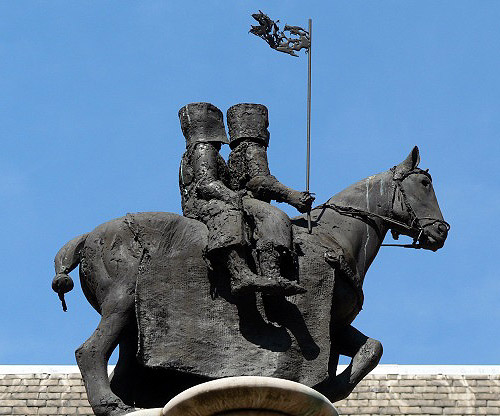
Two Templars "Poor Knights of Christ" depicted at the Temple Church in London |
 |

|
|
|
|
|
|
|


